Cairo reiterates that the sovereignty of Sudan and the unity of its territories and national institutions are "red lines" and rejects the establishment or recognition of any parallel entities.
A joint statement from both countries condemns the targeting of infrastructure by the Rapid Support Forces using drones launched from one of the neighboring countries.
Egypt confirmed on Tuesday its full readiness to take all measures and actions permitted by international law and the mutual defense agreement with Sudan, to ensure that the "red lines" related to its sovereignty, territorial unity, and national institutions are not crossed.
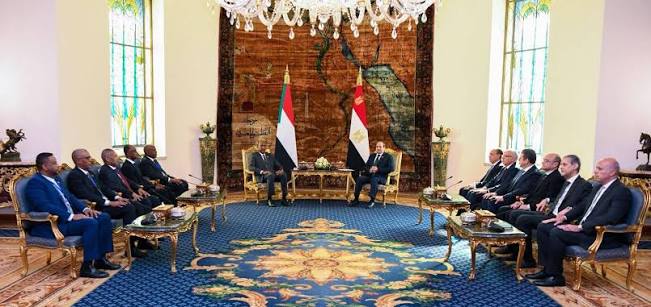
This came in a joint statement issued at the end of a working visit by Sudanese Prime Minister Kamal Al-Tayeb Idris to Egypt, during which he met with President Abdel Fattah El-Sisi and Prime Minister Mostafa Madbouly, according to the Sudanese news agency "SUNA".
According to the statement, the Egyptian side reiterated its rejection of any threat to Sudan's unity and territorial integrity during extensive consultations between Madbouly and Idris in Cairo, emphasizing its continued support for the Sudanese people and their national institutions.
The Egyptian side also reaffirmed the determinants stated in the Egyptian presidential statement issued on December 18, 2025, regarding the "direct link between Egyptian and Sudanese national security".
The statement clarified that these determinants include preserving Sudan's sovereignty and the unity and integrity of its territories, not tampering with its capabilities and those of its people, unequivocally rejecting the establishment or recognition of any parallel entities, and ensuring the preservation of Sudan's state institutions and preventing any harm to them.
In this regard, the statement emphasized "Egypt's complete readiness to take all necessary measures and actions permitted by international law and the mutual defense agreement between the two brotherly countries to support Sudan and ensure that these red lines are not breached or crossed".
The statement did not specify the nature of the measures that Egypt might take or the circumstances that might necessitate resorting to them.
Egypt and Sudan signed the mutual defense agreement in July 1976, which stipulates that any armed attack on either of the two countries is considered an attack on both, and necessitates taking measures to respond, including the use of armed force.
In 1989, the then-Sudanese Prime Minister Sadiq Al-Mahdi announced the unilateral cancellation of the agreement, while Cairo maintains that it remains in effect.
On December 18, 2025, El-Sisi and Sudan's Sovereign Council Chairman Abdel Fattah Al-Burhan called for the reactivation of the agreement to face existing security challenges, without any subsequent official declaration regarding its actual activation.
The two countries condemned in the joint statement issued on Tuesday the targeting of what they described as "rebel militias" (Rapid Support Forces) against civilians and infrastructure in Sudan, particularly power stations and water facilities, through drones which they said were launched from one of the neighboring countries, without specifying which one.
Both sides reiterated their support for Sudan's national institutions, led by the armed forces, to fulfill their constitutional responsibilities in maintaining national security and protecting the country’s borders, wealth, and water rights.
Since April 2023, the Sudanese army has been fighting the Rapid Support Forces over a dispute regarding the latter's integration into the military, resulting in the deaths of tens of thousands of Sudanese and the displacement of 13 million people amid a worsening humanitarian crisis.
Cooperation and Reconstruction
The two countries agreed to enhance cooperation in economic, commercial, developmental, cultural, social, and educational fields, and to facilitate the affairs and care of Sudanese students in Egypt.
They also emphasized the importance of intensifying communication and exchanging official visits, increasing trade exchange, enhancing investment, and exploring avenues for cooperation in the health sector and pharmaceutical industries.
The two sides agreed to settle the status of detainees held in both countries as soon as possible, and to continue coordination to facilitate the voluntary return of Sudanese citizens to their homeland.
Egypt confirmed its readiness to provide all forms of support and assistance to the Sudanese government's reconstruction efforts, while the Sudanese side expressed its hope for the participation of Egyptian companies in rebuilding what was destroyed by the war in the industrial and agricultural sectors and rehabilitating the infrastructure.
The two countries also agreed to continue political coordination and consultation on regional and international issues of mutual interest.
Nile and Red Sea Waters
The two countries stressed the interconnectedness of their water security as "a single, indivisible body," and the necessity of defending their full rights and water uses under the 1959 agreement, and not allowing any infringement upon them.
They agreed to follow up on the implementation of the outcomes of the meetings of the Joint Permanent Technical Committee for Nile Waters and the coordination mechanism between the foreign and irrigation ministers of the two countries, to formulate a unified position on all issues related to Nile waters.
They reiterated their total rejection of any unilateral actions in the Eastern Nile Basin, considering that the Ethiopian Renaissance Dam, "which violates international law," has severe repercussions and represents a constant threat to the two downstream countries.
They called on Ethiopia to change its unilateral policy and restore cooperation in accordance with the rules of international law, especially the principles of no harm, prior notification, consultation, and consensus.
They also affirmed the importance of the Nile Basin Initiative in completing consultations and restoring consensus to establish a comprehensive commission representing all riparian countries.
Regarding the Red Sea, the two countries emphasized respecting freedom of navigation, asserting that "the governance of the Red Sea is the exclusive responsibility of its coastal states".
Both sides rejected any maritime access for a non-coastal state of the Red Sea at the expense of the sovereignty of the coastal states and the unity and integrity of their territories and ports.
They also rejected any attempts to exploit the regional situation to militarize the Red Sea or to take unilateral actions that affect the sovereignty of the regional states and the integrity of their territories.
At the conclusion of the visit, Idris invited Madbouly to visit Sudan and to build upon the results of the Cairo consultations, while both countries renewed their commitment to elevate bilateral cooperation to the level of "comprehensive integration".
Egypt and Sudan are demanding a binding triple agreement to regulate the filling and operation of the Renaissance Dam, while Ethiopia believes that the project does not require a binding agreement, asserting that it does not intend to harm the interests of any other country.
Meeting between El-Sisi and Idris
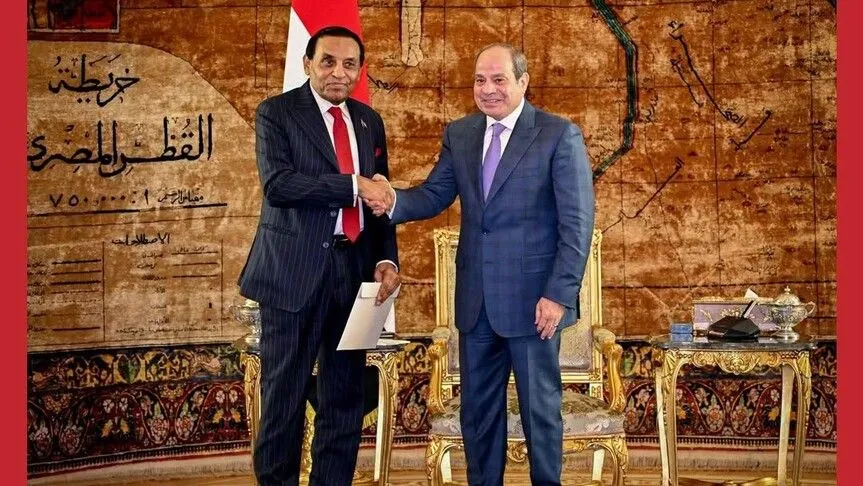
Earlier on Tuesday, El-Sisi received the Sudanese Prime Minister and his accompanying delegation in Cairo, in the presence of Egyptian Foreign Minister Badr Abdel Atti, according to a statement from the Egyptian presidency.
During the meeting, Idris delivered a message from Al-Burhan to El-Sisi, which included reaffirming the uniqueness of the relations between the two countries and Sudan's eagerness to continue working with Egypt to enhance bilateral cooperation in various fields.
El-Sisi affirmed Egypt's commitment to supporting Sudan's unity, sovereignty, and stability, and its rejection and condemnation of any attempts aimed at undermining its security or national institutions.
He referred to the efforts being made by his country to promote a political solution to the current crisis, halt the war, and end the humanitarian suffering in Sudan.
For his part, Idris emphasized the importance of Egypt's support for restoring Sudan's role in the African Union, as well as the internal Sudanese dialogue process that he said would start in Khartoum.
The Sudanese Prime Minister stressed that the dialogue process "will not exclude anyone," without specifying a start date.
He also emphasized his country's reliance on Egypt in recovery and reconstruction efforts and benefiting from the expertise of Egyptian companies in various fields, including infrastructure, energy, and transport.
In response to a Sudanese request, El-Sisi directed a positive review of the conditions of Sudanese prisoners and detainees in Egypt and the possibility of completing their sentences in Sudan, in accordance with the relevant rules and laws, according to a statement from the Egyptian presidency.