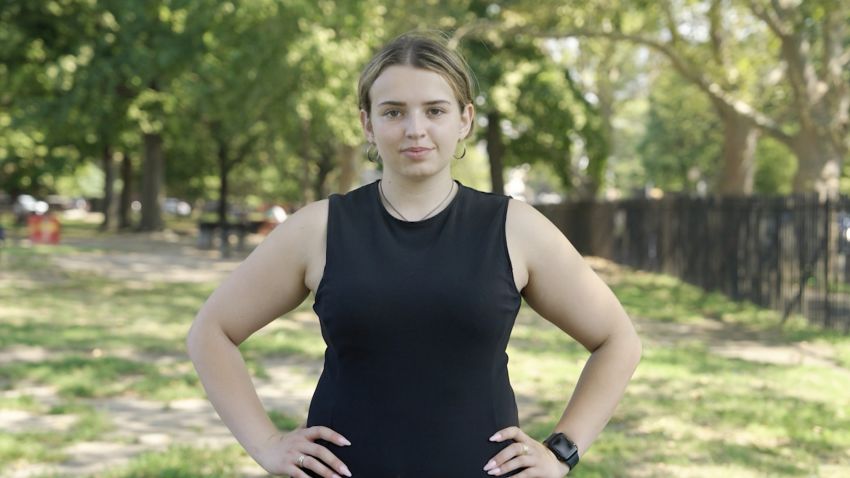
Grimaldi, who is 26 years old and in the later stages of her pregnancy, was in a grocery store in Phoenix, Arizona, when an older woman, standing in front of her in the checkout line, commented on her feet, describing them as "very big and fat," adding that she would be giving birth to "a fat baby."
Grimaldi continued until the woman showed signs of discomfort. Once she successfully silenced her completely, Grimaldi simply turned around and went on with her day.
This phenomenon, referred to as the "Gen Z stare," has sparked much controversy and has been widely discussed on platforms like Reddit and through trending hashtags on social media.
The term relates to individuals born between the late 1990s and the early 2000s.
Its definition was added earlier this year to the Merriam-Webster dictionary under the colloquial terms section, where it was described as "an expressionless stare adopted by Gen Z individuals in situations where they are expected to provide a verbal response."
The definition also added that this stare appears in "classrooms, restaurants, and other social situations, and is often perceived by the other party as a critical look."
But what if this expressionless stare serves as a form of "silent boundary"? And what if we, who receive this stare, are actually the ones making the judgments?

Grimaldi, who is the founder and editor of "The Zillennial Zine," an online magazine targeting a generation that straddles "Gen Z" and "Millennials," believes this tension may stem from a fundamental misunderstanding of intentions.
She explained: "I think part of the generational gap comes from the fact that young people are often expected to be polite, to smile, and maintain a pleasant demeanor when interacting with others, even when the other party is being unnecessarily rude." Generation "Z" does not care for "forced fun."
Grimaldi noted that older generations, like the Baby Boomers and Gen X, may have grown up adopting behaviors characterized by friendliness and politeness in customer service contexts, while Gen Z sees no harm in maintaining a straightforward style when dealing with others, calling this discrepancy a "generational issue."
Lauren Margolis, co-author of the book "Executive Coaching: Perspectives and Practices Across the Field," feels that this generation considers many social interactions, which older generations see as essential for building a positive and polite work environment, to be artificial.
She explained: "Gen Z employees belong to a generation characterized by extreme authenticity; therefore, they refuse to engage in small talk and do not accept what they consider to be fake happiness."

Adapting to the Real World
Communication expert Betsy Patrick and author of "Kids These Days: Effective Strategies for Coaching Gen Z and Beyond" believes that older generations often tend to judge younger generations.
Patrick, who was born in 1983 and identifies as being part of the older Millennial generation, emphasized the importance of older generations considering the upbringing circumstances of Gen Z when receiving certain looks from them.
In Texas, she stated that these looks "may reflect feelings of uncertainty, anxiety, processing things mentally, discomfort, or simply a different perception of what an appropriate response should be."
She also added that the COVID-19 pandemic deprived many young people of years in which they should have gained experiences related to "face-to-face interaction during a critical phase of their development."
This doesn’t mean that Gen Z individuals have lost the ability to communicate, but it may indicate that some members of this generation have had fewer opportunities to engage in spontaneous direct face-to-face interactions or in ongoing reciprocal dialogues, as she noted.
Review your expectations

Kristin Emerson, an organizational consultant based in Maryland, told CNN that it is important for those who encounter this "stare" from Gen Z members to realize that behavior alone does not explain why a person acts that way.
Emerson works to help teams and leaders improve communication, collaboration, and effectiveness in the workplace.
For those who expect overt displays of enthusiasm, or quick verbal responses, or eye contact, or other interaction indicators, the absence of these signals may lead them to believe that something is wrong, but that is not always the case.
Emerson continued: "The Gen Z stare is a behavior that may cause others to over-interpret what they see."
Polite Ways to Deal with the "Gen Z Stare"
If you find yourself confronted with this stare, Emerson advises adopting a "dialogue instead of diagnosis" approach.
She explained: "Instead of assuming that someone, whether from Gen Z or otherwise, is rude, uninterested, or unprofessional simply because they do not show the signals we expect, we can ask a clarifying question, adjust our communication style, and give the other party space to respond in a different way."
And if the person continues to stare, it’s okay to ask them what’s on their mind.
Emerson affirmed that "bringing it up for discussion is acceptable; this generation values transparency. So, if they find someone making observations without passing judgment or blaming or trying to embarrass them, they will be more open to having a dialogue."