Baghdad – The impact of artificial intelligence on the Iraqi job market is no longer just a future possibility, as its tools have begun to gradually enter various office, administrative, and media tasks, with expectations that the scope of influence will widen in the coming years, especially in jobs that rely on routine and repetitive tasks.
While specialists do not expect entire professions to disappear in the near future, they anticipate that the nature of many jobs will change and that the ability to use artificial intelligence tools will become part of employment requirements, which may pose greater challenges for graduates seeking their first job.
The first job opportunity is changing
For Farah, a graduate of the Media College in Baghdad, a university degree was not enough to open the door to the job market as she had hoped.
After graduation, she sent her resume to media institutions, companies, and offices in search of an opportunity in editing, content creation, or administrative work, but she found that competition for entry-level jobs had become tougher.
Farah told Shafaq News Agency: "I was looking for a chance to start, even with a small salary, the important thing was to learn and gain experience. But I started to notice that some of the tasks I was applying for could be largely accomplished using artificial intelligence tools."
She clarifies that tasks that previously represented part of an entry-level employee's work, such as preparing drafts, summarizing information, rewriting texts, and organizing data, can now be completed in a shorter time using artificial intelligence tools.
She adds: "I feel that today's graduate must not only have a degree and some basic skills, but must also know how to use artificial intelligence and develop their digital skills to compete."
Routine is the first affected
Specialist in technologies Ali Karim believes that the transformation has already begun, but it remains limited compared to what is happening in more advanced markets.
Karim told Shafaq News Agency that jobs relying on repetitive procedures will be the most vulnerable to change, including data entry, administrative work, archiving, correspondence, and some accounting tasks, in addition to parts of media work and customer service.
He points out that institutions may find in artificial intelligence a way to reduce time and costs, which could lead to a decreased need for some tasks, but on the other hand, it will create a necessity for new skills related to data, systems, automation, and modern technologies.
Karim sees that the future of employees will not be determined only by their specialization but by their ability to integrate this specialization with technology, considering that those who are proficient in using artificial intelligence tools will be better able to adapt to the new job market.
The job that has not yet been canceled
Economic researcher Ahmed Nizar believes that the greatest impact may not appear in the form of mass layoffs but rather in the decline of new jobs that previously provided a traditional entry point into the job market.
Kazem Ali told Video News Agency that an institution that previously needed several employees to complete repetitive office tasks may be able to accomplish part of the work in the future with fewer employees, thanks to automation and artificial intelligence tools.
This means, according to him, that new graduates may face greater competition in securing their first job, especially in a market that already struggles to absorb large numbers of newcomers.
However, Eid believes that technology will open new fields for those capable of combining their specializations and digital skills, affirming that continuous training will be a decisive factor in maintaining competitiveness.
"The hybrid specialist" in facing change
International economics professor Nawar Al-Saadie believes that fear of artificial intelligence should not lead to abandoning specializations such as management, accounting, and media, but rather to changing the way these disciplines are studied and the related professions are practiced.
Al-Saadie told Shafaq News Agency that routine office jobs will be among the most affected fields, but that does not mean the disappearance of the professions themselves, rather it means redefining the tasks performed by the workers in them.
He gives the example of an accountant who not only possesses financial knowledge but also has skills in data analysis and using artificial intelligence tools, or a journalist who benefits from these tools in gathering information and preparing drafts while maintaining investigative, analytical, and critical thinking skills.
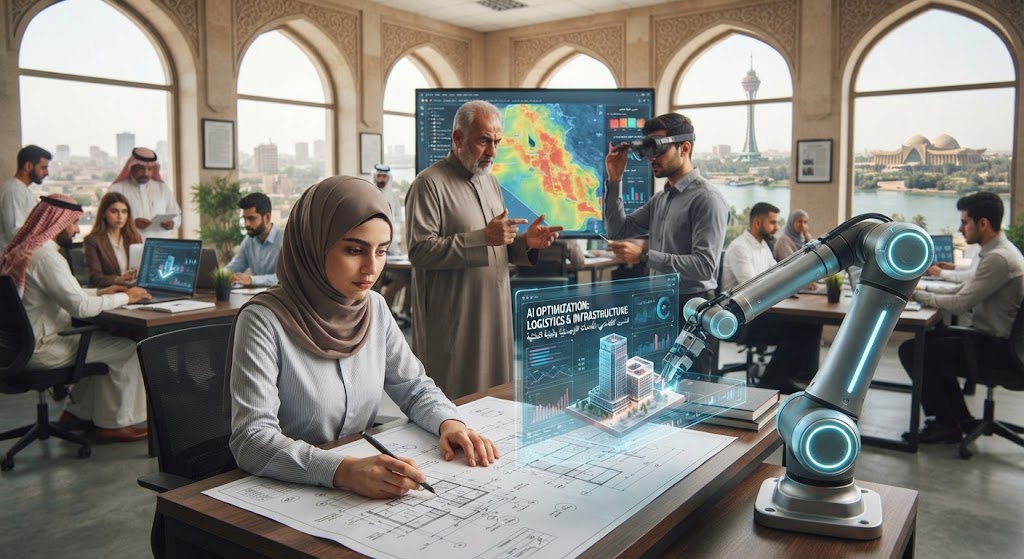
He describes this model as the **"hybrid specialist,"** who combines traditional knowledge with technical skills.
Al-Saadie believes that Iraqi universities must keep pace with this transformation by integrating digital skills and artificial intelligence into curricula, rather than leaving graduates to face the job market after graduation without the necessary tools to compete.
Iraq before a global transformation
These concerns do not arise in isolation from global developments, as countries and international institutions are moving towards studying the impact of artificial intelligence on jobs, particularly for young people and new graduates.
In China, the Ministry of Human Resources and Social Security announced in January 2026 a move towards policies to address the impact of artificial intelligence on jobs and enhance employment opportunities, focusing on graduates and young job seekers.
The International Labour Organization also stated in August 2026 that global youth unemployment reached 12.4% in 2025, or about 67 million young people, while the percentage of youths not engaged in work, education, or training was about 20%.
Other international indicators suggest that some jobs that were the usual entry point for youth into the job market have started to face changes due to technology and artificial intelligence, particularly office, administrative jobs, customer service, and some technical professions.
In the United States, recent analyses showed that artificial intelligence has changed the nature of a number of jobs since the emergence of ChatGPT more than it has led to their elimination, without clear evidence so far that it has caused broad changes in overall employment or unemployment rates.
The skills race begins
In Iraq, it appears that the next battle in the job market will not necessarily be between humans and machines, but between those who possess adaptable skills and those who still rely on tasks that machines can perform.
With artificial intelligence gradually entering institutions, the university degree may only be the beginning of the path, while the ability to use technology, analyze information, think critically, and engage in continuous learning may become essential conditions for securing and retaining a job.
For new graduates, the biggest challenge may be that the job that used to provide them with the necessary experience to build their careers is itself at risk of transformation, making acquiring digital skills before entering the job market more of a necessity than an additional advantage.