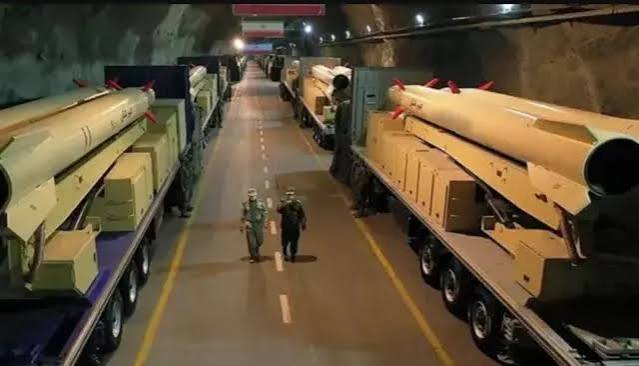
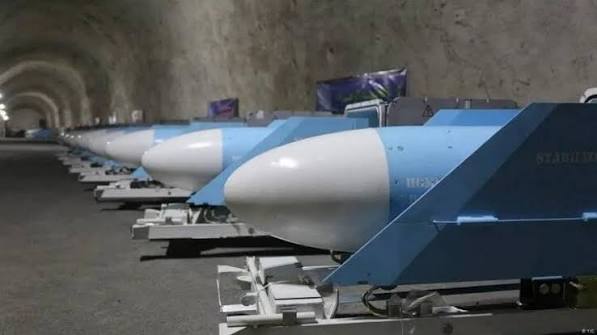
The spokesman for the Revolutionary Guard, Brigadier General Hossein Mohaghebi, stated, describing the achievements of the Aerospace Forces: "Thanks to local knowledge and vast geography, we have been able to create many cities and underground missile production facilities." The spokesman praised the memory of the martyr Major General Dr. Hassan Taheri Moghadam, and the martyrs of the Aerospace Forces of the Revolutionary Guard, during a press conference held on Saturday morning on the occasion of Aerospace Forces Week. The spokesman noted the naming of this week in memory of the martyr Taheri Moghadam, mentioning the names of martyrs such as Salami, Kazemi, Zahedi, Hajizadeh, and Mahmoud Baghiri, saying: "Aerospace Forces Week represents an opportunity to celebrate the status of honorable martyrs, veterans, and every member of the Aerospace Forces of the Revolutionary Guard and their noble families." The spokesman added: "This week is also an opportunity to highlight the important achievements and tasks of this force. I request national media reporters and news agencies, as well as all media activists, to convey these materials, as part of the achievements and missions of the Aerospace Forces, to the kind Iranian people and all the nations of the world." He emphasized that these achievements and missions would not have been possible without the ceremonies, orders, recommendations, and guidance of the martyr Imam of the nation. Local knowledge production; the starting point for transformation in aerospace industry. The spokesman for the Iranian Revolutionary Guard described the accomplishment of the Aerospace Forces as "the production of local knowledge and the localization of global knowledge in the aerospace industry," stating: "This great achievement has become a source of many developments in the country's defense and offensive industries, and in a historic transformation, we have shifted from being an importer of military aerospace weapons to an exporter."
He added: "Thanks to this development, our aerospace technology has outperformed the enemy's aerospace technology in terms of the value contained in the components of this technology." For example, our Shahed 136 drone model has today been replicated in most countries around the world, even in America, and is produced and used under different names; this is a significant development we witness today. The export of the Arman missile, the 357 drone, and the 3 Khordad system. The spokesman for the Revolutionary Guard referred to the second achievement of the Aerospace Forces, saying: "Transforming knowledge into industry and producing many military industries needed by the country is another accomplishment of these forces. Today, our Aerospace industry exports its products to many countries, including the Arman missile, the 357 drone, and the 3 Khordad air defense system." He added: "This is a great achievement we have not witnessed throughout our country's history. We have always been importers of weapons; however, now, in addition to meeting domestic needs, we have also become exporters, and this great achievement is attributed to the Aerospace Forces of the Revolutionary Guard."
Focusing on production and independence in arms supply. The spokesman for the Revolutionary Guard listed the third achievement of the Aerospace Forces as "focusing on production and independence, not on purchasing and reliance," stating: "Today, all our weapons in the Aerospace Force are produced with local knowledge and experience; it is not as if we imported weapons from foreign countries. Even these products are not a result of reverse engineering from war spoils taken from the enemy." He added: "This is a great success we have achieved over time, and today we are independent in military industry, especially in aerospace industry. We do not need to import weapons from other countries, bring military advisors for training on weapons, or supply spare parts for war equipment from abroad, and we must pay attention to this great achievement." Continuous firing under intense enemy bombardment. The spokesman for the Revolutionary Guard about the fourth achievement of the Aerospace Forces: "Producing the capability for field management to use light and heavy weapons in both short and long-range during war and crisis conditions under enemy bombardment is another achievement of this force." He continued: "As you witnessed, despite the intense bombardment of the enemy, our fire continued consistently according to the schedule, targeting the enemy's assets, funds, personnel, and equipment, to the point where the enemy could not prevent the Aerospace operations carried out by the Revolutionary Guard." Establishing a balance of power relying on missiles, drones, and electronic warfare. Brigadier General Mohaghebi described the fifth achievement of the Aerospace Forces as establishing a balance of power by focusing on missiles, drones, and electronic warfare, stating: "By giving us superiority in the field of missiles, we were able to establish resistance and deterrence against the enemy's equipment;
And by focusing on drone production, we significantly affected the enemy; thanks to electronic warfare, we were able to overcome enemy technology." He added: "In the last week or two, we managed to gain control of six enemy reconnaissance drones of the 'MQM-170' model and safely bring them down. This is conclusive evidence of our technological superiority over enemy technology. The weapons brought by the enemy to the battlefield are their latest weaponry, and our ability to overcome them and safely bring down their drones is a great achievement." The Aerospace Forces of the Revolutionary Guard have shot down more than 260 hostile aircraft. The spokesman for the Revolutionary Guard, in discussing the sixth achievement, said that: "The rapid and technical entry into defense systems production is another achievement of the Aerospace Forces, which began this rapid advancement after the Twelve-Day War, and during this short period, the Aerospace Forces reached a level of development that enabled them to confront more than 260 hostile aircraft and shoot most of them down during the Ramadan War." He referred to F-35, F-16, F-15 fighter jets, RQ-4 drones, Orbiter drones, Lucas drones, and several other smaller enemy aircraft, stating: "This number exceeding 260 aircraft is different from the figures presented by the Iranian Islamic Republic Army. They have also achieved successes in this area, and have announced their statistics, still announcing them. The statistics I mentioned relate only to the Aerospace Forces of the Revolutionary Guard.